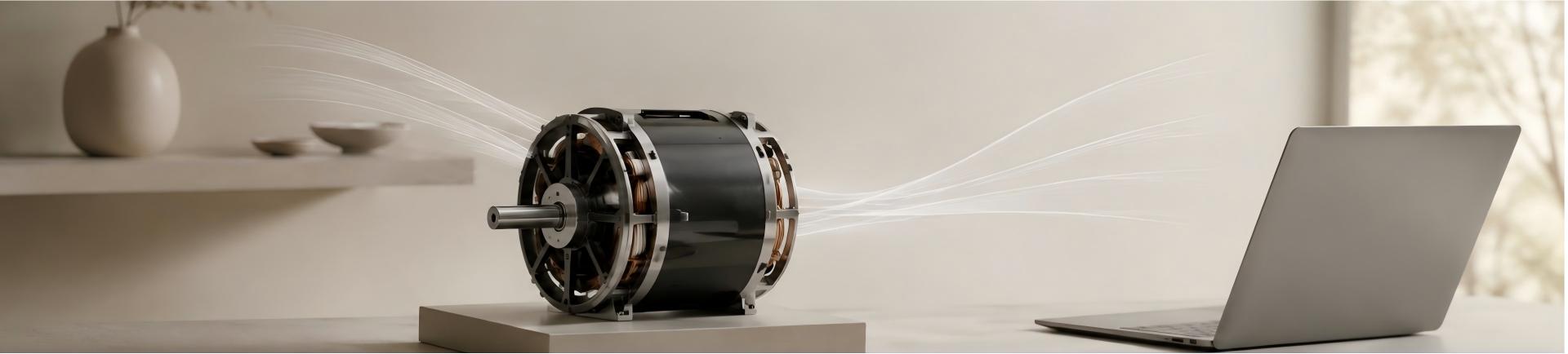
Replacing a range hood fan motor involves disconnecting electrical power, accessing the blower assembly, removing the defective motor, and installing a compatible replacement. The procedure requires correct wiring, mounting dimensions, and safety checks, so electrical repairs should be performed by qualified personnel.
A range hood motor should be considered for replacement when confirmed mechanical or electrical failure prevents normal operation.
Common symptoms include unusual noise, unstable speed, overheating, and complete failure to start.
However, poor ventilation does not always mean the motor is defective.
Grease buildup on the blower wheel, clogged filters, damaged wiring, and defective control components can also affect performance.
Before purchasing a replacement motor, the technician should confirm the actual cause.
The required tools depend on the range hood model.
Typical preparation may involve screwdrivers, appropriate hand tools, electrical testing equipment, protective gloves, and the correct replacement components.
Most importantly, the electrical supply must be isolated before the motor compartment is opened.
A qualified technician should verify that the equipment is de-energized and follow the manufacturer's service instructions.
Some electronic range hoods contain capacitors or control circuits that may retain hazardous voltage after disconnection.
The following is a general overview rather than a model-specific repair procedure.
01 - Disconnect Electrical Power
Switch off the appropriate circuit and verify that the equipment is electrically isolated.
02 - Remove Accessible Components
Depending on the model, grease filters and access panels may need to be removed to reach the blower assembly.
03 - Inspect the Existing Motor
Check for visible damage, loose connections, grease buildup, or mechanical obstruction.
04 - Identify the Motor Specifications
Record the model number, voltage, power, speed, mounting arrangement, and wiring configuration.
05 - Remove the Defective Motor
A qualified technician disconnects the motor and removes its mounting components according to the manufacturer's instructions.
06 - Install the Replacement
The compatible motor is positioned and secured using the approved mounting arrangement.
07 - Reassemble the Range Hood
Reconnect the approved electrical components and reinstall the protective covers, filters, and blower components.
08 - Test the System
After the equipment has been safely reassembled, verify starting performance, airflow, noise, speed adjustment, and normal operation.
The replacement process should stop if wiring or component compatibility cannot be confirmed.
No. Exhaust fan motors are not universally interchangeable.
| Specification | Why It Matters |
|---|---|
| Voltage | Must match the electrical system |
| Power and Torque | Must suit the fan load |
| Motor Speed | Affects airflow performance |
| Shaft Dimensions | Must match the blower wheel |
| Mounting Structure | Determines installation compatibility |
| Control System | Must match the motor technology |
| Rotation Direction | Must suit the impeller design |
A BLDC motor cannot normally replace a conventional AC motor simply by connecting the original wires.
A BLDC system requires a compatible electronic driver and appropriate power conversion or control arrangement.
When a manufacturer plans to upgrade a range hood product from a conventional motor to a BLDC design, the complete system should be evaluated.
The motor must match the blower wheel, airflow resistance, installation space, and required speed range.
The driver must also be compatible with the motor's electrical characteristics.
Our Commercial Kitchen Hood Exhaust Fan Motor illustrates a low-power motor configuration available for suitable kitchen ventilation applications.
For OEM development, our team can review dimensions, voltage, winding characteristics, and driver requirements before sample approval.
A successful replacement should restore more than basic rotation.
Important checks include:
01 - Reliable motor starting
02 - Correct rotation direction
03 - Stable airflow
04 - Acceptable vibration
05 - Normal operating current
06 - Controlled motor temperature
07 - Functional speed adjustment
08 - Secure mounting and wiring
For production applications, testing with the actual blower wheel and housing provides more useful information than testing an unloaded motor alone.
HUALIDA manufactures BLDC fan motors and provides motor customization services for appliance manufacturers and component suppliers.
Our engineering discussions cover shaft dimensions, installation structure, winding parameters, operating speed, and matched electronic controls.
We recommend confirming compatibility before mass production or replacement-parts purchasing.
Our Custom BLDC Motor Solutions provide further information about motor and driver matching for different fan applications.
For exhaust fan manufacturers, repair-parts distributors, and appliance brands, selecting a compatible motor is essential for reliable operation.
Our team can review existing motor data, application drawings, electrical requirements, and purchasing quantities.
Discuss Your Range Hood Motor Requirements