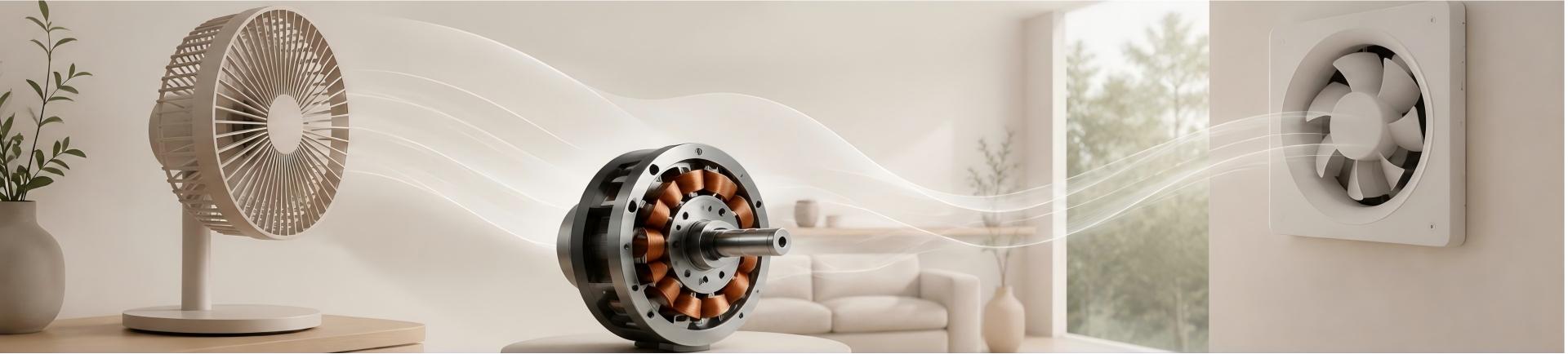
Pedestal fans are different from fixed ceiling fans or wall-mounted exhaust fans. The finished product can be moved between rooms, adjusted to different heights, and directed toward a specific area. Because of this product structure, the motor needs to work with the fan blade, grille, head assembly, oscillation structure, speed settings, and intended operating environment.
The final airflow, noise, stability, and energy consumption of the pedestal fan depend on the complete product design. The motor provides the driving force, but its performance must be matched with the finished fan rather than evaluated separately.
The motor is positioned inside the fan head, directly behind the blade and protective grille.
Its shaft connects with the blade hub, allowing the motor to turn the fan blade when power is supplied. The fan head is then supported by the stand, height-adjustment tube, and base of the finished pedestal fan.
Although the motor is hidden inside the product, it influences several parts of the user experience:
Blade rotation
Airflow stability
Available speed levels
Operating noise
Temperature rise
Long-hour operation
Fan head weight
Product balance
A Pedestal Fan Motor therefore needs to fit both the internal fan-head structure and the expected use of the finished fan.
BLDC Motors are used in modern pedestal fan products to drive the blade under different speed and operating requirements.
The motor works together with the blade, fan housing, grille, mounting bracket, and control system. When these components are properly matched, the finished pedestal fan can provide steady airflow across several operating levels.
The main task of the Pedestal Fan Motor is to turn the blade at the required speed.
As the blade rotates, it draws air from behind the fan and pushes it forward through the grille. The airflow can then be directed toward the user by adjusting the fan-head angle or moving the complete fan.
The motor must match the blade design because blade diameter, quantity, pitch, weight, and material can affect the required driving force.
A motor that is suitable for a smaller household fan may not be suitable for a larger pedestal fan with heavier blades.
Finished pedestal fans commonly provide several airflow levels.
A lower setting may be used for sleeping, reading, or close-range airflow, while a higher setting may be selected for larger rooms or warmer conditions.
The BLDC Motor needs to operate steadily across the intended speed range of the finished fan.
The number of speed levels and the required rotational range should be confirmed according to the actual pedestal fan design.
Unlike a ceiling fan, a pedestal fan can be relocated according to the user’s needs.
The motor supports this movable air-circulation function by driving the fan blade inside a compact fan head.
This makes the finished product suitable for spaces where permanent fan installation is not required or where airflow needs to be redirected during the day.
Many pedestal fans include a left-to-right oscillation function.
The Pedestal Fan Motor drives the blade, while the oscillation mechanism moves the complete fan head across a wider area.
These are separate mechanical functions, but they need to work together inside the finished fan.
The motor should provide stable blade rotation while the fan head changes direction during oscillation.
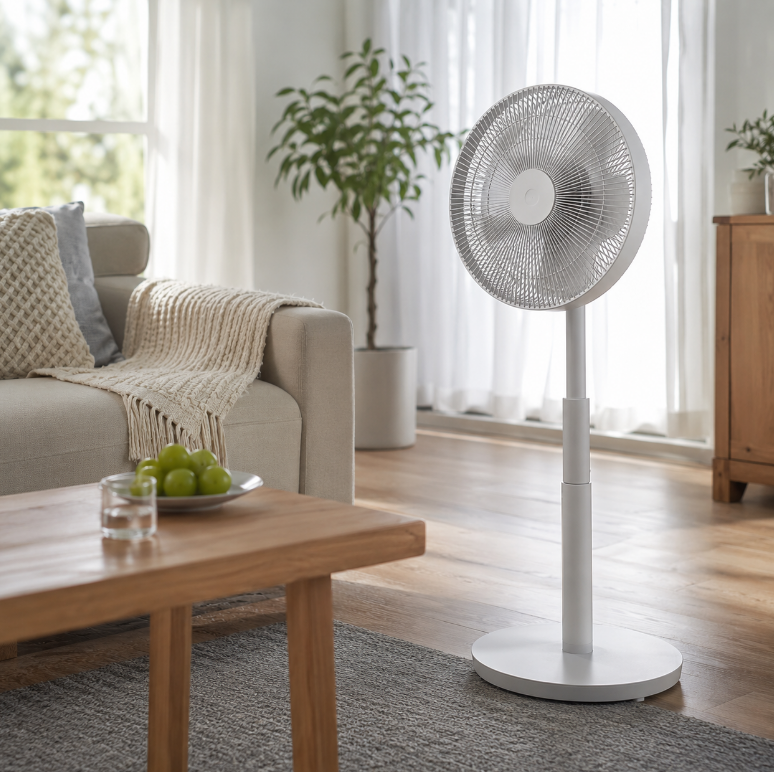
Pedestal fans are used in a wide range of indoor environments. The motor application should be evaluated according to the room, operating duration, blade structure, and expected airflow.
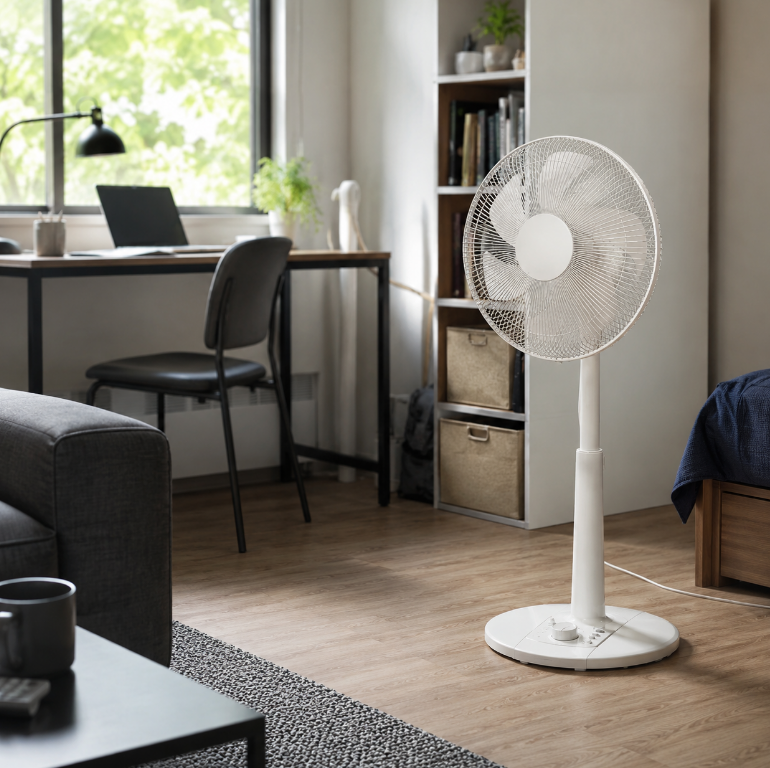
In residential living rooms, pedestal fans are commonly used to supplement indoor cooling and improve local air movement.
The fan may be positioned beside a sofa, near a window, or in an open seating area.
A Pedestal Fan Motor for this application should match the finished fan’s blade size, speed range, and expected operating time.
The final fan may be used alone during mild weather or together with air-conditioning to improve air distribution.
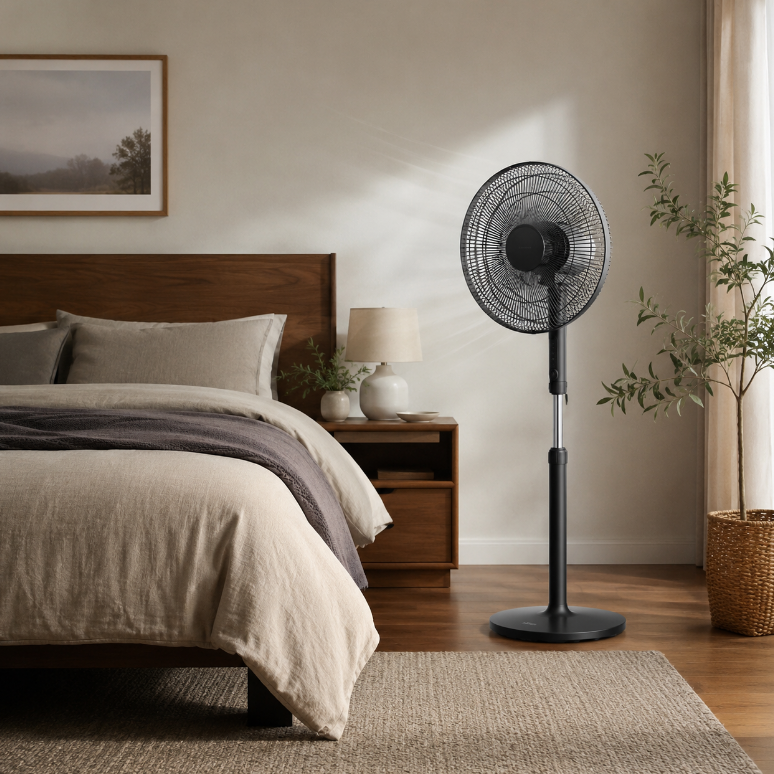
Pedestal fans are also used in bedrooms where users want adjustable and movable airflow.
The fan can be placed at different distances from the bed and adjusted to a suitable height.
For bedroom use, the complete product may focus more on lower-speed operation, stable airflow, and reduced disturbance during rest.
The motor should be evaluated together with the blade balance, grille, mounting structure, and complete fan-head design.
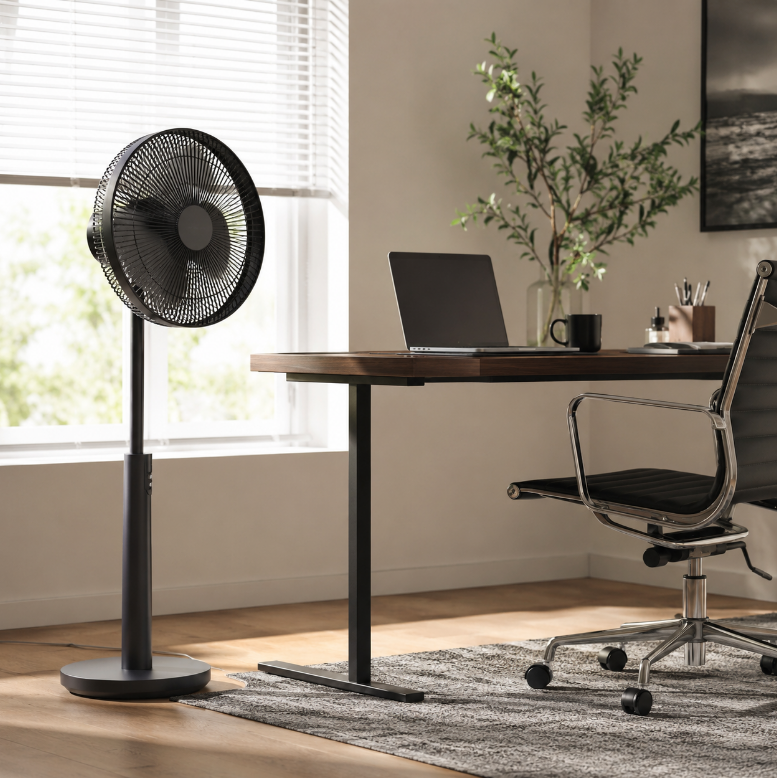
Offices may use pedestal fans to improve airflow around workstations, meeting areas, or reception spaces.
The finished fan may operate for several hours during the working day.
The motor application should therefore consider expected operating time, airflow requirements, fan size, and indoor temperature conditions.
Pedestal fans can be used in shops, service counters, waiting areas, and reception spaces where flexible cooling is needed.
The fan can be moved according to customer flow or seasonal requirements.
A suitable BLDC Pedestal Fan Motor supports the finished product in providing directed airflow without requiring permanent ceiling or wall installation.
In classrooms and training rooms, pedestal fans may be positioned near seating areas or used to improve air movement across part of the room.
The motor needs to work with a fan blade and grille suitable for frequent indoor use.
The final product design should also consider stability, base size, protective grille, and fan placement.
Larger pedestal fans may be used in small workshops, studios, storage areas, restaurants, or other light commercial environments.
These applications may require a different blade size, motor load, and operating duration from a standard household fan.
The Pedestal Fan Motor should be selected according to the actual finished fan rather than using a household motor specification without evaluation.
Pedestal fans are available in different sizes, appearances, and functional configurations.
Two fans may both be described as pedestal fans but use different motor solutions because of changes in the blade, housing, and fan-head structure.
Compact models are designed for bedrooms, apartments, and smaller rooms.
They commonly use a lighter blade and a smaller fan head.
The motor needs to fit the available internal space and match the product’s intended airflow range.
Larger pedestal fans use wider or heavier blades to move air across a broader area.
The motor requirement may change because the blade load and expected airflow are different.
Blade diameter, weight, material, and target speed should be provided when evaluating the motor.
Many finished pedestal fans use a telescopic stand that allows the user to change the fan height.
The motor remains inside the fan head, but the complete product balance can be affected by the weight of the motor and blade assembly.
The fan-head structure, support bracket, stand, and base should therefore be considered together.
Some pedestal fans include remote-control functions or electronic speed selection.
The BLDC Motor provides the mechanical drive for the blade, while the control function belongs to the complete fan system.
Our supply scope focuses on the motor product. Remote controls, drivers, control boards, mobile applications, and complete fan control systems are not included unless separately confirmed.
Finished pedestal fans may include display panels, timers, or multiple operating modes.
These functions do not change the motor’s basic role: driving the fan blade.
However, the required speed range and operating modes should be confirmed so the motor can be evaluated for the intended finished product.
The Pedestal Fan Motor is only one part of the complete fan. Its application needs to be reviewed together with the surrounding components.
The blade converts motor rotation into airflow.
Blade diameter, number, pitch, material, and weight can influence the motor requirement.
The motor and blade should therefore be evaluated as a matched combination.
The grille protects users from the rotating blade and forms part of the fan-head structure.
A dense or poorly designed grille may affect airflow resistance and the final performance of the fan.
The complete fan-head design should be considered when evaluating the application.
The motor is mounted inside the rear housing of the pedestal fan.
The housing determines the available installation space, mounting-hole positions, ventilation openings, and wiring direction.
Accurate dimensions help reduce structural mismatch during assembly.
The oscillation mechanism moves the fan head from side to side.
This mechanism is separate from the main blade-driving motor in many fan designs.
The Pedestal Fan Motor should maintain stable operation while the finished fan is oscillating.
The stand supports the fan head and allows height adjustment.
The base keeps the complete pedestal fan stable during operation.
Although these parts are not directly driven by the motor, their strength and balance affect the safety and stability of the finished fan.
Before selecting or developing a BLDC Motor for a pedestal fan, the following details should be reviewed.
The blade load directly affects the motor requirement.
Buyers should provide the blade diameter, quantity, material, and approximate weight.
The required operating speed should match the desired airflow levels of the finished fan.
The lowest and highest speed requirements should be confirmed when possible.
Motor power should be selected according to the blade load, speed requirement, and operating conditions.
A larger power rating does not automatically produce a better pedestal fan. The motor needs to match the complete product.
The internal dimensions of the fan head determine which motor structures can be installed.
Housing drawings, mounting dimensions, and an original sample can help confirm compatibility.
The motor shaft connects with the blade hub.
Shaft length, diameter, thread, and connection method should be confirmed before sample development.
Pedestal fans may operate for short periods or continuously for several hours.
The expected daily running time should be provided during the application review.
The electrical requirements should match the destination market and complete fan design.
Voltage, frequency, wiring, and connector information should be confirmed before production.

Household pedestal fans and light commercial pedestal fans may use similar product structures, but their operating requirements can differ.
A household fan may focus on compact size, flexible placement, and everyday room cooling.
A light commercial fan may operate for longer periods or use a larger blade to cover a wider area.
The motor application may therefore differ in:
Blade load
Speed range
Operating duration
Fan-head size
Housing ventilation
Target airflow
Product positioning
The buyer should clearly identify the intended use of the finished pedestal fan when requesting a motor solution.
To evaluate a Pedestal Fan Motor application, please provide:
Finished pedestal fan type
Blade diameter
Blade quantity and material
Approximate blade weight
Required motor speed
Required motor power
Shaft dimensions
Fan-head installation space
Mounting-hole arrangement
Wiring and connector information
Operating voltage and frequency
Expected operating time
Target market
Original motor sample or drawing
Estimated purchasing quantity
This information helps determine whether the BLDC Motor can match the blade and internal structure of the finished pedestal fan.
A Pedestal Fan Motor should be selected according to the complete fan product.
Using only the motor diameter or appearance as a reference can create problems during assembly or operation.
A suitable application review should consider the blade, fan head, oscillation structure, housing, stand, base, speed requirements, and electrical system.
Providing an original motor sample, product drawing, or finished fan sample allows the motor manufacturer to evaluate the application more accurately.
Send us your pedestal fan application, original motor sample or drawing, blade information, required speed and power, installation dimensions, voltage, frequency, target market, and expected order quantity.
Our team will review the application and discuss a suitable BLDC Motor solution for your finished pedestal fan product.
Send Your Motor Sample
Request a Pedestal Fan Motor Quote
Previous: Table Fan
Next: Ventilation Fan