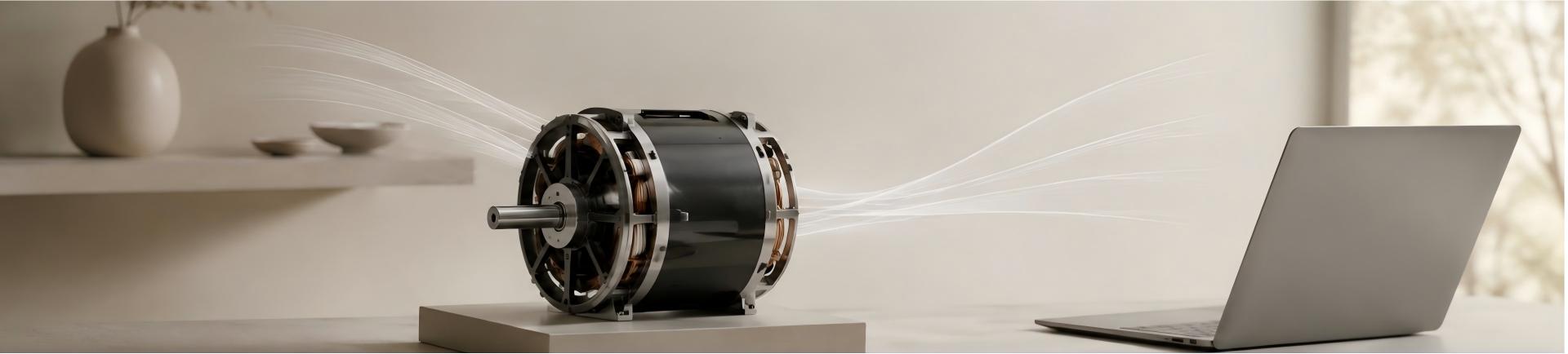
Choosing a brushless DC motor requires matching voltage, speed, torque, efficiency, physical dimensions, and electronic control requirements to the intended application. For fan manufacturers, the correct BLDC motor must also work with the actual blade load, housing structure, airflow resistance, and operating conditions.
A BLDC motor converts electrical energy into mechanical rotation using electronically controlled magnetic fields.
Its stator contains electrical windings, while the rotor uses permanent magnets.
An electronic driver switches current through the stator windings in a controlled sequence.
The changing magnetic field drives the rotor and produces shaft rotation.
Unlike a conventional brushed DC motor, a BLDC motor does not require mechanical brushes for commutation.
This design allows the motor controller to manage speed and operating characteristics electronically.
Several characteristics make BLDC motors suitable for modern fan applications.
01 - High Efficiency Potential
Brushless construction and optimized electronic control can reduce energy losses.
02 - Flexible Speed Regulation
The driver can support multiple speed levels, variable-speed operation, or application-specific control modes.
03 - Reduced Mechanical Brush Wear
The absence of carbon brushes eliminates brush-related friction and replacement requirements.
04 - Compact Motor Construction
Suitable BLDC designs can provide useful performance within restricted installation spaces.
05 - Adjustable Control Functions
Driver programs can support soft starting, speed transitions, and selected protection functions.
However, actual performance depends on the complete motor and driver design.
Before choosing a motor, buyers should define the application requirements.
| Parameter | Selection Consideration |
|---|---|
| Rated Voltage | Must match the power system |
| Rated Speed | Should meet application requirements |
| Starting Torque | Must overcome initial load |
| Running Torque | Must support continuous operation |
| Rated Power | Should match operating demand |
| Motor Dimensions | Must fit the product housing |
| Shaft Dimensions | Must match the driven component |
| Driver Type | Must support motor control |
| Temperature Rise | Must remain within safe limits |
| Noise and Vibration | Must meet product targets |
For fan applications, torque and speed should be evaluated together.
Selecting a motor only by wattage may produce disappointing results when the actual blade load is considered.
The correct motor should be selected using the complete fan structure.
A larger blade or steeper blade pitch generally changes the torque required for operation.
Ducts, filters, grilles, and protective shutters may also influence the airflow resistance encountered by ventilation equipment.
For this reason, motor selection should include:
01 - Fan blade diameter and weight
02 - Required airflow
03 - Target speed range
04 - Static pressure requirements
05 - Starting torque
06 - Available installation space
07 - Shaft and mounting dimensions
08 - Driver control requirements
Our Custom BLDC Motor Solutions are developed around these types of application-specific requirements.
BLDC motors are used in different fan categories.
Ceiling Fans
Require controlled airflow, multiple speed levels, and suitable acoustic performance.
Table Fans
Benefit from compact construction and stable low-speed operation.
Pedestal Fans
May require greater torque for larger fan blades.
Exhaust Fans
Need suitable performance under ventilation resistance and operating conditions.
Air Circulation Fans
Often require a flexible speed range and smooth airflow adjustment.
Different applications require different motor configurations even when they use similar BLDC technology.
The driver is an essential part of the motor system.
It controls winding energization, speed response, and the motor's electronic commutation.
Different motors may require different control algorithms, current limits, and connection arrangements.
Our Brushless DC Motor Driver Circuit is an example of a control component used in compatible fan systems.
For OEM buyers, the motor and driver should be evaluated together during sample testing.
Our HUALIDA manufacturing team develops BLDC motor solutions for fan manufacturers and equipment suppliers.
We can discuss customization of motor dimensions, shaft structures, winding parameters, electrical performance, and compatible driver settings.
Our engineering process begins with the customer's application requirements.
Motor samples can then be evaluated with the actual blade and housing to assess starting performance, current, speed, vibration, and temperature behavior.
This helps reduce compatibility problems before mass production.
A practical procurement checklist includes:
01 - Application and motor type
02 - Electrical specifications
03 - Mechanical dimensions
04 - Required speed and torque
05 - Driver compatibility
06 - Sample performance testing
07 - Noise and temperature requirements
08 - Product quality documentation
09 - OEM customization options
10 - Production and delivery requirements
For fan manufacturers, confirming these specifications before tooling approval can help avoid later structural modifications.
HUALIDA supplies brushless DC motor solutions for ceiling fans, ventilation equipment, table fans, pedestal fans, and related air-moving products.
Our factory can support motor configuration reviews, selected OEM/ODM customization, matched driver development, and bulk production planning.