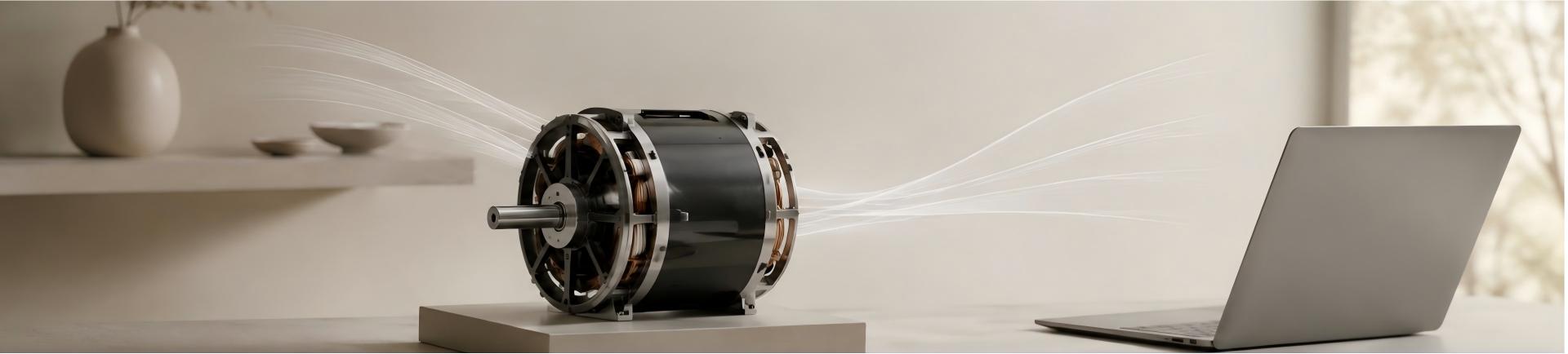
A BLDC motor is a brushless direct-current motor that uses permanent magnets and electronic commutation to produce efficient, quiet, and controllable rotation.
A traditional brushed DC motor transfers current through physical brushes and a commutator.
A BLDC motor uses:
Permanent magnet rotor
Stator windings
Electronic driver
Position feedback or sensorless control
Bearings
Motor housing
The driver switches current through the stator windings in the correct sequence. This creates a rotating magnetic field that interacts with the permanent magnet rotor.
Because there are no physical brushes, the motor avoids brush friction, brush dust, and regular brush replacement.
The rotor normally contains permanent magnets. The stator contains copper windings arranged in phases.
When the driver energizes different stator phases, the magnetic field changes position. The rotor follows this moving field and produces continuous rotation.
Important construction elements include:
Rotor magnet strength
Stator winding design
Number of poles
Air gap
Bearing structure
Shaft size
Housing design
Heat-dissipation path
Sensor arrangement
A change in any of these elements can affect torque, speed, efficiency, vibration, temperature, and noise.
The driver is responsible for electronic commutation and motor control.
It may manage:
Start-up
Speed adjustment
Direction
Current output
Motor protection
Overheating protection
Stall protection
Remote commands
Communication with other control components
A BLDC motor should not be evaluated without considering its driver. Motor and driver parameters must be matched according to voltage, current, winding, magnet configuration, speed range, and application load.
BLDC motors provide several advantages:
Electronic commutation and permanent magnet construction can improve power conversion and reduce mechanical losses.
The absence of brushes reduces contact noise and allows smoother speed control.
The motor does not require regular brush replacement, although bearings and electronic components still require suitable protection.
The driver can regulate motor speed more accurately than many basic AC systems.
Reverse rotation, remote control, timer settings, memory functions, and multiple speed levels can be integrated into the system.
BLDC motors are widely used in:
Ceiling fans
Table fans
Pedestal fans
Wall fans
Exhaust fans
Kitchen ventilation
Bathroom ventilation
Industrial air movement
Air circulation equipment
Appliance motor systems
The factory’s product categories cover BLDC motors, driver boards, remote controls, and LED modules for fan and ventilation applications.
In a ceiling fan, the BLDC motor drives the blades and controls rotation speed.
The motor system must match:
Fan blade diameter
Blade weight
Required airflow
Speed range
Ceiling height
Noise target
Remote-control functions
Light module
Installation structure
A motor that performs well in a table fan may not be suitable for a large ceiling fan. Torque, heat dissipation, and starting behavior must be evaluated according to the complete fan assembly.
BLDC motors may be customized according to:
Motor diameter
Mounting holes
Shaft structure
Rated voltage
Rated power
Speed range
Torque
Connector
Driver board
Control function
Housing design
The factory provides OEM and ODM customization based on customer drawings, samples, fan applications, and electrical requirements.
The custom motor solution can be considered when a standard motor cannot meet the required installation or performance conditions.
Motor testing may include:
Starting performance
Speed stability
Torque output
Power consumption
Noise
Vibration
Temperature rise
Driver compatibility
Continuous operation
Overload response
The complete motor and fan assembly should be tested together. Motor-only testing cannot fully show blade balance, housing resonance, or final airflow performance.
A reliable supplier should provide:
Motor development
Driver matching
Sample testing
Electrical documentation
Quality inspection
Production consistency
Export packaging
Technical support
After-sales response
The manufacturer has more than 10 years of industry experience, a 12,000㎡ facility, an ISO 9001-certified system, and daily production capacity of approximately 30,000 units.
For customized BLDC motors, driver boards, matched fan controls, or OEM product development, discuss the application with the engineering team through the request a quote page.